


Magnetic Resonance Imaging (MRI) Berlin-Frohnau
This type of diagnostic test is conducted externally. MRI scans, also known as magnetic resonance imaging, are a form of imaging that produces detailed cross-sectional images of the human body. Unlike computed tomography (CT) scans, MRI scans do not use ionising radiation. Instead, they use strong magnetic fields and radio waves to create images of tissues and organs.
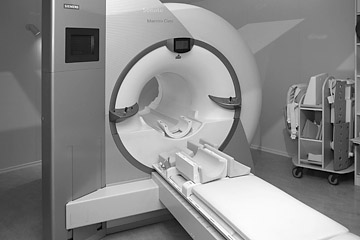
How MRI works
MRI is based on the magnetic properties of hydrogen protons in the body. In a strong magnetic field, these protons align themselves along the field lines. Targeted radio waves excite the protons, causing them to move out of their equilibrium position. When they return to their original state, they emit signals that are registered by receiver coils and converted into detailed images by the computer. This procedure makes it possible to visualise tissues with a high water content, such as brain, muscle and connective tissue, in high resolution.
MRI applications
- orthopaedics: assessment of joints, cartilage, ligaments and tendons, for example in the case of meniscus injuries or herniated discs.
- neurology: diagnosis of brain tumours, multiple sclerosis, strokes and other neurological disorders.
- Cardiology: examination of the heart to detect myocardial damage, heart valve defects and vascular anomalies.
- Oncology: detection and characterisation of tumours and monitoring of the success of therapy.
The high level of detail provided by MRI makes it possible to detect pathological changes at an early stage and to assess them precisely.
Advantages of MRI
- No ionising radiation: Unlike X-rays and CT, MRI works without harmful radiation.
- High soft tissue contrast: It provides excellent visualisation of soft tissue structures.
- Versatility: Different sequences allow adaptation to different diagnostic questions.
Disadvantages and limitations
- Longer examination time compared to CT
- Sensitivity to movement: patients must remain still during the scan.
- Limitations with metallic implants: certain implants can affect image quality or pose a risk.
- Safety and risks
MRI is considered a safe procedure. For some examinations, contrast agents may be administered to better visualise certain structures. In rare cases, patients may experience an allergic reaction to the contrast agent. Patients with metallic implants or electronic devices in their bodies should inform the doctor before the examination, as the strong magnetic field can affect these.
Conclusion
Magnetic resonance imaging is an indispensable diagnostic tool in modern medicine. It provides a detailed, radiation-free image of the inside of the body and helps doctors to diagnose and plan the treatment of a wide range of diseases. Nevertheless, individual factors and possible contraindications should always be taken into account to ensure safe and effective use.